Download (PDF, ePub, Mobi) The Knowledge-Creating Company: How Japanese Companies Create The Dynamics Of Innovation Ebook Read Online
The Knowledge-Creating Company: How Japanese Companies Create The Dynamics Of Innovation
Download or read The Knowledge-Creating Company: How Japanese Companies Create The Dynamics Of Innovation eBook in pdf, epub, kindle, word, txt, ppt, Mobi, rar and zip format. There is no limit to the number of books you can download. The Knowledge-Creating Company: How Japanese Companies Create The Dynamics Of Innovation looks good in design, features and function. The ideal purpose of this system really is simple to clean up and control. The design and style and layout are quite fantastic that make it really appealing and beauty. Many people feel drawn to purchase and utilize it. Every feature is developed to fulfill people require becasue it is function too. It is stunning and ideal product for uncomplicated setup, upkeep, and control device..

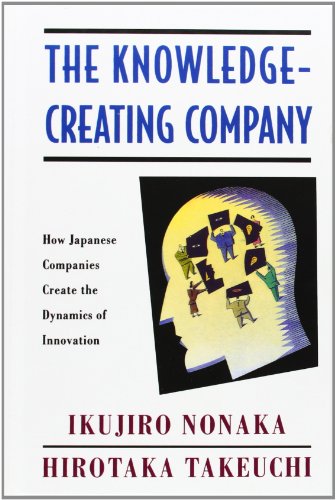
Features The Knowledge-Creating Company: How Japanese Companies Create The Dynamics Of Innovation
Honestly, this product is quite smart function, healthy and safety for users. The Knowledge-Creating Company: How Japanese Companies Create the Dynamics of Innovation is very important to finish all user requires. The design is incredibly light, appealing and elegant one. With the most recent innovation, this device can meet all individuals expectation with fantastic function and function. It is easy to purchase from the dedicated vendor. Individuals could possibly get to get it on the internet over the internet by this site. Owner is quite helpful serve and send out of the product in time shipment. This can be very exceptional service for any good quality product. The only one characteristic to take into consideration about the product that there is not a soul felt trouble and dissatisfied with it. It truely does work perfectly because the ads said previously.
Descriptions The Knowledge-Creating Company: How Japanese Companies Create The Dynamics Of Innovation
Re-decorating a key point to take into account, as consumer self-confidence using companies over others dictates that more of their goods are actually purchased and utilized on satisfaction. You'll certainly have an overabundance of security buying from one of these popular suppliers.After you've done many of the search, there's the last thing to see and perhaps use to perform your selection process. Suppose you've got narrowed your responsibility into 3 products , however they are uncertain picking the someone to buy.
How have Japanese companies become world leaders in the automotive and electronics industries, among others? What is the secret of their success? Two leading Japanese business experts, Ikujiro Nonaka and Hirotaka Takeuchi, are the first to tie the success of Japanese companies to their ability to create new knowledge and use it to produce successful products and technologies. In The Knowledge-Creating Company, Nonaka and Takeuchi provide an inside look at how Japanese companies go about creating this new knowledge organizationally.
The authors point out that there are two types of knowledge: explicit knowledge, contained in manuals and procedures, and tacit knowledge, learned only by experience, and communicated only indirectly, through metaphor and analogy. U.S. managers focus on explicit knowledge. The Japanese, on the other hand, focus on tacit knowledge. And this, the authors argue, is the key to their success--the Japanese have learned how to transform tacit into explicit knowledge.
To explain how this is done--and illuminate Japanese business practices as they do so--the authors range from Greek philosophy to Zen Buddhism, from classical economists to modern management gurus, illustrating the theory of organizational knowledge creation with case studies drawn from such firms as Honda, Canon, Matsushita, NEC, Nissan, 3M, GE, and even the U.S. Marines. For instance, using Matsushita's development of the Home Bakery (the world's first fully automated bread-baking machine for home use), they show how tacit knowledge can be converted to explicit knowledge: when the designers couldn't perfect the dough kneading mechanism, a software programmer apprenticed herself with the master baker at Osaka International Hotel, gained a tacit understanding of kneading, and then conveyed this information to the engineers. In addition, the authors show that, to create knowledge, the best management style is neither top-down nor bottom-up, but rather what they call "middle-up-down," in which the middle managers form a bridge between the ideals of top management and the chaotic realities of the frontline.
As we make the turn into the 21st century, a new society is emerging. Peter Drucker calls it the "knowledge society," one that is drastically different from the "industrial society," and one in which acquiring and applying knowledge will become key competitive factors. Nonaka and Takeuchi go a step further, arguing that creating knowledge will become the key to sustaining a competitive advantage in the future.
Because the competitive environment and customer preferences changes constantly, knowledge perishes quickly. With The Knowledge-Creating Company, managers have at their fingertips years of insight from Japanese firms that reveal how to create knowledge continuously, and how to exploit it to make successful new products, services, and systems.
The authors point out that there are two types of knowledge: explicit knowledge, contained in manuals and procedures, and tacit knowledge, learned only by experience, and communicated only indirectly, through metaphor and analogy. U.S. managers focus on explicit knowledge. The Japanese, on the other hand, focus on tacit knowledge. And this, the authors argue, is the key to their success--the Japanese have learned how to transform tacit into explicit knowledge.
To explain how this is done--and illuminate Japanese business practices as they do so--the authors range from Greek philosophy to Zen Buddhism, from classical economists to modern management gurus, illustrating the theory of organizational knowledge creation with case studies drawn from such firms as Honda, Canon, Matsushita, NEC, Nissan, 3M, GE, and even the U.S. Marines. For instance, using Matsushita's development of the Home Bakery (the world's first fully automated bread-baking machine for home use), they show how tacit knowledge can be converted to explicit knowledge: when the designers couldn't perfect the dough kneading mechanism, a software programmer apprenticed herself with the master baker at Osaka International Hotel, gained a tacit understanding of kneading, and then conveyed this information to the engineers. In addition, the authors show that, to create knowledge, the best management style is neither top-down nor bottom-up, but rather what they call "middle-up-down," in which the middle managers form a bridge between the ideals of top management and the chaotic realities of the frontline.
As we make the turn into the 21st century, a new society is emerging. Peter Drucker calls it the "knowledge society," one that is drastically different from the "industrial society," and one in which acquiring and applying knowledge will become key competitive factors. Nonaka and Takeuchi go a step further, arguing that creating knowledge will become the key to sustaining a competitive advantage in the future.
Because the competitive environment and customer preferences changes constantly, knowledge perishes quickly. With The Knowledge-Creating Company, managers have at their fingertips years of insight from Japanese firms that reveal how to create knowledge continuously, and how to exploit it to make successful new products, services, and systems.
Comments
Post a Comment